Revealing hidden structure
from spectral data





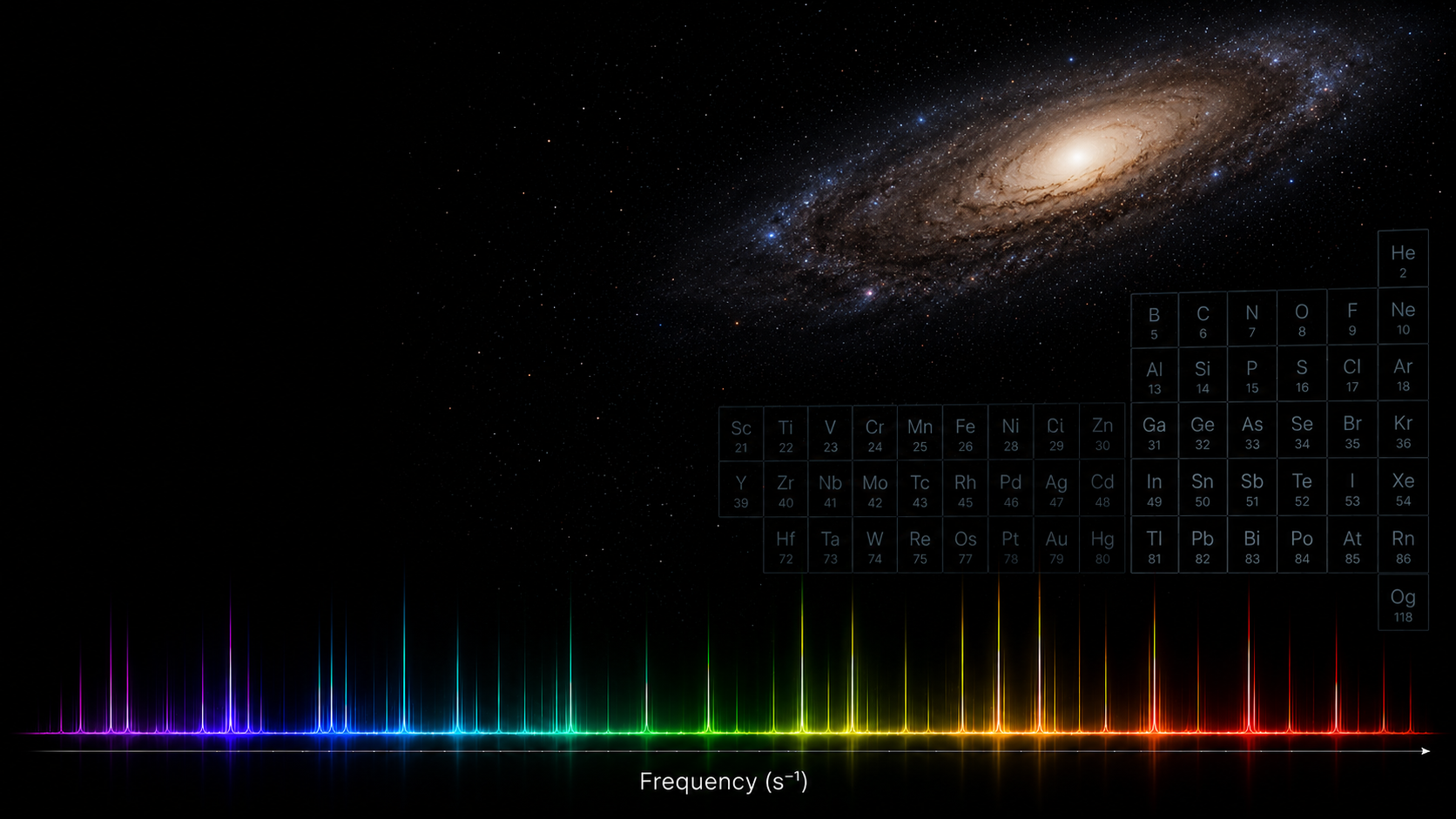
The Spectral Framework is a scientific methodology that identifies an empirical layer of organization underlying atomic physics and chemistry directly in the measurement space of spectral frequencies, without imposing theoretical or representational constructs as primary organizing principles.
By analyzing over a century of atomic spectral data compiled by the National Institute of Standards and Technology (NIST), the framework identifies a unified low-dimensional spectral structure spanning atomic systems across elements and scales. Within this approach, atomic spectra appear not as isolated datasets requiring independent theoretical construction, but as a continuous relational spectral hierarchy.
This organization enables the framework to predict the K-edge of every element from the K-edge of a single element using only a simple scaling law relating two spectral frequencies., rather than the complex calculations and supercomputers often required by current theoretical approaches. More broadly, the spectral structure exhibits extreme predictive compression and empirical closure (organization, generalization, prediction, and explanation) prior to the introduction of any theoretical model.
The Spectral Framework does not introduce additional representational entities such as spacetime, particles, forces, orbitals, dimensions, or quantum mechanisms. It is therefore not an ontological theory of reality. Rather, it is a scientific methodology and a minimal mathematical description of the organization and predictive structure already present within the spectral measurements themselves.
The eye sees only what the mind is prepared to comprehend.
Henri Bergson